Optimising Post-Approval Regulatory Change Management for Pharmaceutical Products in Hong Kong - Case Studies from China and the United States
CHAN, Philip Pan*; KWONG, Rex Lok Fung
Fortune Pharmacal Co. Ltd., Block A & Block B, 50-68 Wang Lok Street, Yuen Long Industrial Estate, Yuen Long, New Territories, Hong Kong SAR, China
(*Corresponding author)
Pharmacy Education & Practice
HKPharm J Volume 33, NO 2 May-Aug-2026 (2026-09-20): P.45
 Abstract
 Full Article
 Author's Information
 List of Reference
 Content
 Share
ABSTRACT
Post-approval changes are essential to ensuring that pharmaceutical products maintain quality, safety, and supply continuity throughout their lifecycle. Many regulatory authorities have adopted risk-based frameworks that classify changes according to their potential impact and apply proportionate controls. It ranges from prior approval for high-risk changes to notification or annual reporting for low-risk changes. These systems also avoid the routine withdrawal of safe pre-change stock, reducing waste and supporting stable supply chains.
In contrast, Hong Kong's current system requires pre-approval for all changes and mandatory full withdrawal of pre-change stock regardless of risk level, resulting in unnecessary delays, resource strain, and product destruction. This article examines risk-based post-approval change management and stock transition practices in China (NMPA) and the United States (FDA), highlighting their classification systems, timelines, and approaches to stock retention. It then outlines the practical benefits, implementation challenges, and key considerations for Hong Kong. Stakeholder collaboration among regulators, industry pharmacists, and academia is also essential to successful adoption.
INTRODUCTION
Post-drug registration approval change management is an inevitable part of a pharmaceutical product's lifecycle. These changes must be managed effectively to ensure quality, safety, and efficacy while maintaining supply continuity.
The International Council for Harmonisation (ICH) Q12 guideline, "Technical and Regulatory Considerations for Pharmaceutical Product Lifecycle Management", provides a framework for managing post-approval changes in a predictable and efficient manner (1). Central to this framework is a risk-based approach that categorises changes according to their potential impact on product quality, safety, and efficacy, with three regulatory pathways: prior approval, notification, and recording. Such risk-based categorisation enables regulatory authorities to apply proportionate controls: low-risk changes face minimal regulatory oversight, while high-impact changes receive focused review.
Major authorities worldwide have adopted frameworks aligned with ICH Q12, using tiered systems to differentiate changes by risk. These include China's National Medical Products Administration (NMPA)(2), the United States Food and Drug Administration (US FDA)(3), the European Medicines Agency (EMA)(4), Health Canada(5), Taiwan FDA(6), Singapore Health Sciences Authority (HSA)(7), and South Korea Ministry of Food and Drug Safety (MFDS)(8). Another common feature across these systems is that pre-change stock withdrawal is required only when changes affect quality, safety, or efficacy, not routinely for all approved changes.
In contrast, Hong Kong's current regulatory framework takes a conservative approach. It requires pre-approval for all changes and mandatory full withdrawal of pre-change stock, regardless of risk level or impact (9).
In addition, locally, the Chief Executive's 2024 Policy Address envisions establishing a "Hong Kong FDA" (which is actually now named the Hong Kong Centre for Medical Products Regulation (CMPR)) to enhance competitiveness and foster the life and health technology industry (10). Adopting a risk-based framework aligned with ICH Q12 would support this vision by aligning Hong Kong with international best practices, improving regulatory efficiency and facilitating potential regulatory collaboration.
This article aims to first examine the current regulatory landscape in Hong Kong. It then explores how two major regulators — China's NMPA and the United States FDA — have implemented risk-based post-approval change frameworks in line with ICH Q12 principles to inform the development of relevant pathways in Hong Kong. It also discusses the potential benefits and drawbacks of such an approach, explores implementation considerations for Hong Kong, and describes how collaboration among regulators, industry, and pharmacists can support successful adoption.
HONG KONG REGULATORY CONTEXT
In Hong Kong, the regulatory framework governing pharmaceutical product changes is established under the Pharmacy and Poisons Regulations (Cap. 138A), and the relevant legislative provisions are set out in Table 1 below(11).
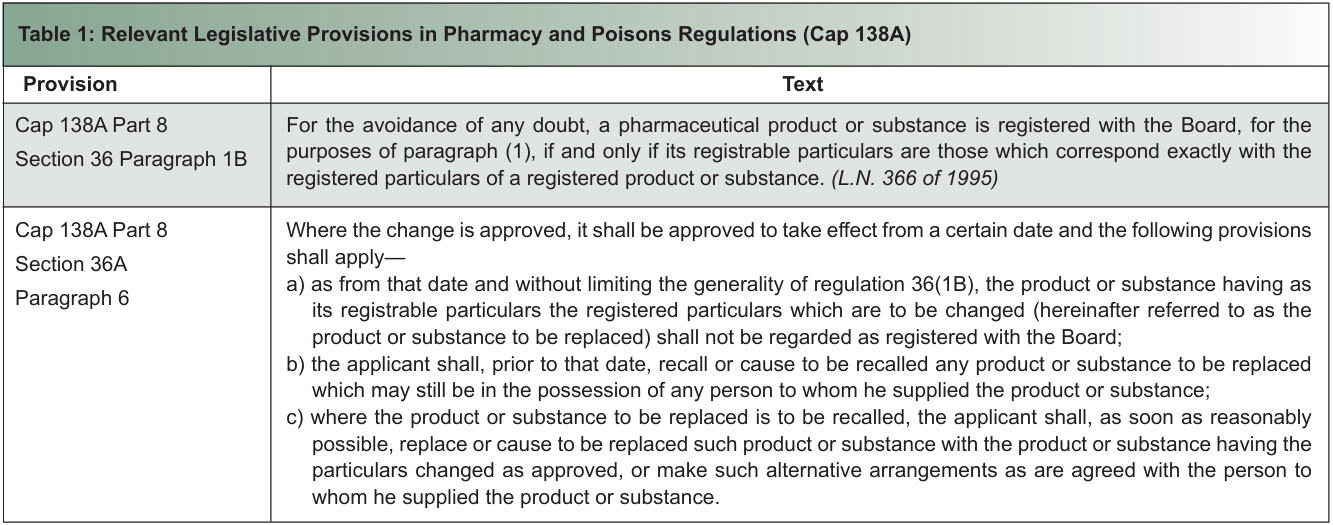
According to these regulations, any change to the registered particulars of a pharmaceutical product requires prior approval by the Pharmacy and Poisons Board of Hong Kong (PPBHK) before implementation, irrespective of the nature or impact of the proposed change.
Furthermore, Cap. 138A also mandates that all pre-change stocks must be fully recalled from the market before the effective date of an approved change. This policy applies even to low-risk changes such as non-substantive artwork updates or minor labelling modifications.
While this approach aims to ensure product integrity and patient safety, it results in several drawbacks including:
- Prolonged Approval Timelines: Even minor changes must navigate the same approval pathway as major changes, causing potential delays in change approval and implementation.
- Inefficient Use of Regulatory Resources: Limited resources are diverted from high-impact reviews to processing low-risk changes.
- Unnecessary Destruction of Safe Medicines: Routine mandatory recall of pre-change stock destroys safe, effective products regardless of whether the change affects quality, leading to financial losses for industry and contributing to pharmaceutical waste in landfills.
These drawbacks highlight the gap between Hong Kong's current practice and the risk-based principles outlined in ICH Q12, which have been adopted by major regulators worldwide. The following sections will examine how two major regulators — China's NMPA and the US FDA — have implemented these principles in practice.
POST-APPROVAL REGULATORY CHANGES PROCESS IN CHINA
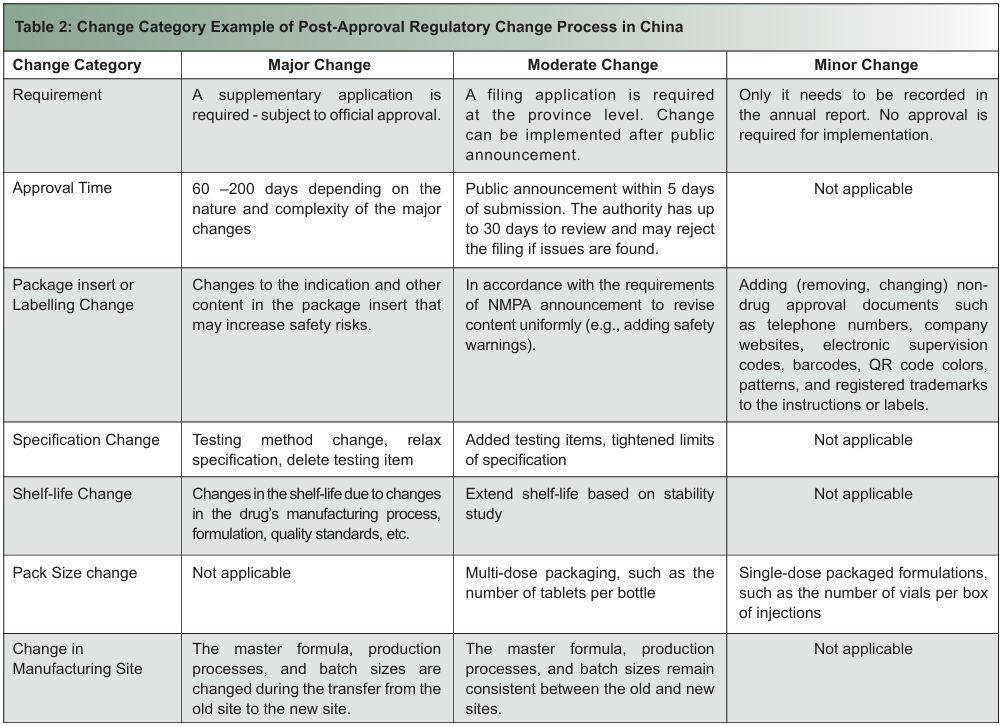
China's NMPA adopts a risk-based three-tier classification system for post-approval changes, which can streamline regulatory processes while ensuring product quality and safety (12). The three categories are (2):
- Major changes(重大變更): Require an application with approval before implementation. These apply to significant modifications, such as active ingredient alterations or major process changes, which could critically affect product performance.
- Moderate changes(中等變更): Require filing for record (notification) before the change implementation to the province level authority. In general, a public announcement for the changes can be found in authority websites within 5 days, indicating the approval of change implementation. Further technical review may be initiated after the public announcement. These typically apply to changes with moderate risk, such as changes to shelf life or tightening of product specifications (13).
- Minor changes(微小變更): Reported via annual report only, with no prior approval needed. These apply to changes that pose minimal risk and examples are corrections to package insert typographical errors or changes to pack size.
In addition, pre-change stocks do not require recall unless the changes are related to quality, safety, or efficacy defects, a practice that differs from Hong Kong's current approach. Drawing from our direct experience in managing changes for products registered in China, manufacturing equipment changes that preserve the same working principle, as well as changes to excipients, are typically classified as minor changes and do not necessitate stock withdrawal. Similarly, package insert updates may be classified as minor or moderate depending on the context and likewise do not mandate the withdrawal of pre-change stock.Table 2 below provides the review timeframe and categorisation of specific change types under the NMPA system (14).
POST-APPROVAL REGULATORY CHANGE PROCESS IN THE UNITED STATES
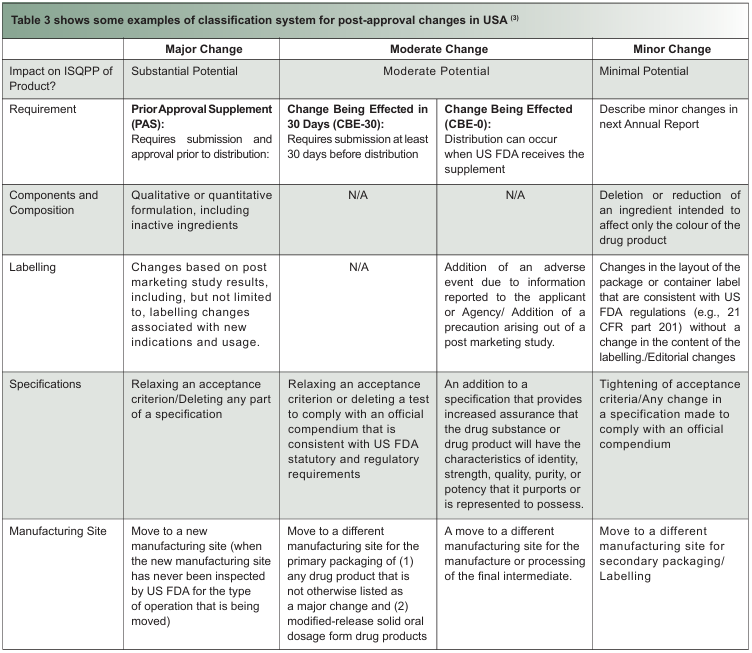
The US FDA employs a similar 3-tier categorisation system for Chemistry, Manufacturing and Controls (CMC) post-approval changes, based on their potential impact on the product’s identity, strength, quality, purity, or potency (ISQPP) (3). The three categories are:
- Major changes: Require a “Prior Approval Supplement” (PAS) that must receive an US FDA approval before distributing any product made with the change, which have substantial potential to adversely affect product quality, safety, or efficacy (such as manufacturing site changes, master formula changes or new container closure systems)
- Moderate changes: Require a “Changes Being Effected” (CBE) supplement. CBE-30 submissions (e.g., certain process optimisations or analytical method changes) can be implemented 30 days after US FDA receipt unless objected to, while lower-risk CBE-0 changes (e.g., some labelling or minor equipment updates) allow immediate implementation upon submission. The change should pose a moderate potential impact on ISQPP of Product
- Minor changes: Only described in the next annual report, requiring no prior US FDA review or approval, presenting minimal risk to product quality (such as editorial labelling updates or alternative analytical procedures providing equivalent assurance).
Apart from the change system, there is no requirement for a mandatory withdrawal of pre-change stock unless defects are identified. This approach reduces regulatory burden and facilitates timely product updates, supporting manufacturers’ competitiveness and enhancing patient access to improved therapies.
Table 3 shows some examples of classification system for post-approval changes in USA (3)
POTENTIAL BENEFITS OF THE RISK-BASED APPROACH
A risk-based approach to manage post-approval changes application offers several distinct advantages over Hong Kong's current approach.
Reduced Wastage and Improved Stock Transition
Risk-based pre-change product withdrawal significantly decreases destruction of safe and quality products that remain on the market, thereby reducing environmental impact from waste disposal, supporting stable drug supply chains and minimising economic losses for manufacturers.
Accelerated Implementation for Low-Risk Changes
Faster handling of low-risk changes enables shorter implementation timelines, delivering more up-to-date products to patients quickly while enhancing competitiveness for local manufacturers and importers. This is exemplified by NMPA's minor change annual reporting category and US FDA's CBE-0 immediate-effect category, which provide predictable regulatory outcomes and enable manufacturers to plan and respond to market demands efficiently.
Optimised Resource Allocation
Categorising changes by risk allows regulatory authorities to allocate resources efficiently, enabling them to focus detailed scientific review on major post-approval changes, generic drug applications, and new chemical or biological entity applications that potentially have a higher impact on quality, safety, or efficacy. Moderate and minor changes can follow streamlined notification or annual reporting routes without delaying supply. In this way, resource utilisation and regulatory capacity are optimised.
IMPLEMENTATION CONSIDERATIONS IN HONG KONG
Adopting a risk-based post-approval change management system in Hong Kong presents several challenges that must be addressed to ensure successful implementation. These include legislative constraints, public confidence, transition management, and digital infrastructure limitations.
Legislative Constraints
The Pharmacy and Poisons Ordinance currently lack explicit provisions permitting risk-based stock retention for low-risk post-approval changes, creating a major legislative obstacle. Amending the regulations is necessary to permit selective stock transition, for example, retaining pre-change batches when no quality or safety defects are present. This would align Hong Kong with ICH Q12 lifecycle principles and international best practices, while reducing environmental impact and maintaining patient safety.
Public Confidence and Safety Oversight
A risk-based system depends on companies' internal judgment rather than direct regulatory review. This creates a vulnerability: a high-risk change misclassified as minor may escape proper scrutiny. As a result, problematic products could reach the market before issues are detected. Problems may only emerge later through complaints, adverse events, or inspections, potentially leading to more recalls and greater public health risks. Beyond these safety concerns, public confidence may also suffer if misclassification or quality oversights raise alarm.
To address this, the regulatory authority can issue clear guidelines with concrete examples of risk categories. Hosting industry seminars and webinars would help train stakeholders on risk assessment, fostering transparency and showing that patient safety remains the priority.
Regional Classification Variation
Although ICH Q12 provides a harmonisation framework, regional differences across regulators remain a practical consideration for Hong Kong. Companies operating in multiple markets may face classification inconsistencies. For instance, a minor change under the NMPA may be considered a moderate change (requiring CBE-30 submission) under the US FDA.
This variation is not a flaw of the risk-based system itself, but it is a reality that Hong Kong regulators should consider when designing classification criteria. Aligning Hong Kong's framework with internationally recognised categories can help reduce submission burdens for companies managing changes across multiple markets.
Transition Management
Transitioning to a risk-based system demands significant upfront planning for resources, training, and cross-functional change management. Consulting industry associations enables the development of a practicable timeline. Pilot programmes focused on low-risk changes can be introduced to ensure a smooth rollout without overwhelming operations.
Digital Infrastructure Limitations
Hong Kong currently uses the Pharmaceuticals Registration System 2.0 (PRS 2.0) for online application submissions. However, the platform is not designed for tiered submissions, posing a technical barrier to adoption. It handles uniform "change of particulars" application but cannot distinguish between different routes. Revamping PRS 2.0 with modular workflows such as instant minor change acknowledgments and dashboards can enable streamlined operations and data integrity.
COLLABORATION OF STAKEHOLDERS
Successful implementation of a risk-based framework will require active collaboration among regulators, industry, and pharmacists. Each stakeholder group brings unique expertise that can contribute to a well-designed and practical system.
Technical Contribution
Pharmacists from both industry and academia can contribute to framework design by applying their practical chemistry, manufacturing, and controls (CMC) knowledge and regulatory expertise to define precise risk categories tailored to Hong Kong’s pharmaceutical landscape. For instance, they can help establish criteria that distinguish major changes—such as a change in manufacturing sites—from minor ones, like the addition of pack sizes or minor label modifications.
Using tools such as Failure Mode and Effects Analysis (FMEA) helps quantify impacts on product quality and patient safety. This input ensures that categories reflect real-world scenarios, preventing overly conservative classifications that could compromise regulatory efficiency.
Effective Stock Transition and Communication
Industry pharmacists play a key role in planning and overseeing stock transitions. They can help evaluate whether withdrawal of pre-change inventory is necessary, which is required only when an impact assessment identifies quality or safety defects.
They also coordinate batch disposition decisions, liaise with distributors and customers through clear change notifications, and minimise confusion. Furthermore, the industry can gather and share feedback on post-approval changes, helping regulators build confidence in low-risk stock retention and develop practical stock management guidelines.
Post-Marketing Surveillance and Continuous Improvement
Pharmacists and industry serve as frontline reporters of adverse events and quality complaints within Hong Kong's pharmacovigilance system. They provide regulators with data to assess whether specific post-approval changes or stock practices introduce risk. Through annual reports or joint working groups, their feedback enables continuous improvement of the risk-based framework, allowing classifications and stock guidance to be adjusted in response to emerging trends.
CONCLUSION
Risk-based categorisation of post-approval regulatory changes, combined with pragmatic stock transition rules, offers a clear pathway to reduce product wastage, shorten regulatory timelines, and optimise resource utilisation without compromising product quality, safety, or efficacy. The case studies from China and the United States demonstrate the feasibility and advantages of such systems.
Hong Kong stands to benefit by adapting these principles to its own regulatory environment. This would not only align the territory with international best practices but also enhance its competitiveness and support its ambition to become a regional hub for life and health technologies.
However, successful implementation will require careful planning. Key considerations include addressing legislative constraints, maintaining public confidence, managing the transition effectively, and upgrading digital infrastructure to support tiered submissions.
Most importantly, success will depend on sustained collaboration among regulatory authorities, industry, and the pharmacy profession. By working together, these stakeholders can design and implement an optimised post-approval regulatory change framework that serves both public health and Hong Kong's strategic development goals
Acknowledgement
We sincerely thank Cindy Cheung, Regulatory and Medical Affairs Manager at Fortune Pharmacal Co., Ltd., for sharing her detailed insights on the regulatory frameworks of the Hong Kong SAR, China NMPA, and the US FDA.
References
- International Council For Harmonisation of Technical Requirements for Pharmaceutical for Human Use. ICH Harmonised Guideline - Technical And Regulatory Considerations for Pharmaceutical Product Lifecycle Management Q12 [Internet]. 2019 Nov 19 [cited 2026 Mar 13]. Available from: https://www.ich.org/page/quality-guidelines
- 中華人民共和國司法部. 药品注册管理办法 [Internet]. 2020 [cited 2026 Mar 27]. Available from: https://www.moj.gov.cn/pub/sfbgw/flfggz/flfggzbmgz/202101/t20210105_146465.html
- U.S. Department of Health and Human Services Food and Drug Administration. Guidance for Industry - Changes to an Approved NDA or ANDA [Internet]. 2004 [cited 2026 Mar 27]. Available from: https://www.fda.gov/media/71846/downloadl
- European Commission. COMMISSION REGULATION (EC) No 1234/2008 of 24 November 2008 concerning the examination of variations to the terms of marketing authorizations for medicinal products for human use [Internet]. 2008 [cited 2026 Mar 27]. Available from: https://eur-lex.europa.eu/eli/reg/2008/1234
- Health Canada. Guidance Document: Post-Notice of Compliance (NOC) Changes: Quality Document [Internet]. 2018. [cited 2026 Mar 27]. Available from: https://www.canada.ca/en/health-canada/services/drugs-health-products/drug-products/applications-submissions/guidance-documents/post-notice-compliance-changes/quality-document/guidance.html#t2.1
- 全國法規資料庫 - 藥品查驗登記審查準則 [Internet]. 2026 [cited 2026 Mar 27]. Available from: https://law.moj.gov.tw/LawClass/LawAll.aspx?pcode=L0030057
- Health Sciences Authority. Overview of variation application types [Internet].[cited 2026 Mar 27]. Available from: https://www.hsa.gov.sg/therapeutic-products/variation-application/overview
- Ministry of Food and Drug Safety. Guideline on Post Approval Change Management of Pharmaceutical Manufacturing Process [Internet]. 2024 [cited 2026 Mar 27]. Available from: https://www.mfds.go.kr/eng/brd/m_1127/view.do?seq=6&srchFr=&srchTo=&srchWord=&srchTp=&itm_seq_1=0&itm_seq_2=0&multi_itm_seq=0&company_cd=&company_nm=&page=1
- Pharmacy and Poisons Board of Hong Kong. Guidance Notes on Change of Registered Particulars of Registered Pharmaceutical Products/Substances [Internet]. 2025 [cited 2026 Mar 27]. Available from: https://www.ppbhk.org.hk/eng/doc/guidelines_forms/copGuide_en.pdf?v=9bpohs
- The Chief Executive’s 2024 Policy Address [Internet]. 2024 [cited 2026 Mar 27]. Available from: https://www.policyaddress.gov.hk/2024/en/policy.html
- Cap. 138A Pharmacy and Poisons Regulations [Internet]. [cited 2026 Mar 13]. Available from: https://www.elegislation.gov.hk/hk/cap138A?xpid=ID_1438402707439_002
- National Medical Products Administration. 药品上市后变更管理办法(试行) [Internet]. 2021 [cited 2026 Mar 13]. Available from: https://www.nmpa.gov.cn/yaopin/ypggtg/20210113142301136.html?type=pc&m=
- 广东省药品监督管理局. 广东省药品监督管理局关于印发《广东省药品监督管理局药品上市后变更管理实施细则》的通知 [Internet]. 2023 May 15 [cited 2026 Mar 27]. Available from: https://mpa.gd.gov.cn/zwgk/gzwj/content/post_4180938.html
- Centre For Drug Evaluation, NMPA. 已上市化学药品药学变更研究技术指导原则(试行) [Internet]. 2021 Feb 10 [cited 2026 Mar 27]. Available from: https://www.cde.org.cn/main/news/viewInfoCommon/4ec3dca752a82347bdf24ad3d3e85113
Author’s Background
CHAN, Philip Pan is currently the Quality Assurance Manager at Fortune Pharmacal Co. Ltd in Hong Kong. His email address is philip.chan.pan@fortunepharm.com
KWONG, Rex Lok Fung is currently the Assistant Quality Assurance Pharmacist at Fortune Pharmacal Co. Ltd in Hong Kong. His email address is rex.kwong@fortunepharm.com

